


CK USAID ICAN ANNUAL ACTIVITY REPORT
Food security & livelihoods improvement
Agriculture is the main or only source of income, food and general livelihoods for orphaned and vulnerable households. They are often faced with situations where they have to sell part of their agricultural produce to pay for basic needs, such as health facilities, school fees and shelter. This has largely been attributed to poor farming methods, prolonged droughts, pests and diseases.
CARITAS focuses on empowering families with long term skills to increase food production through modern farming and agronomic practices. Beneficiaries are trained on post-harvest handling methods to ensure quality produce stored for future consumption especially during periods of scarcity. This intervention targets vulnerable households with limited land access, high levels of food insecurity, widow/child headed households, unemployment, poor sanitation and few livestock.
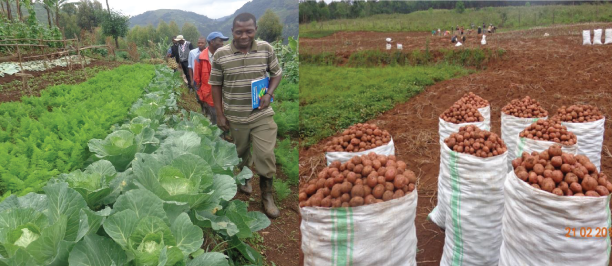
Improving production and productivity through proper agronomic practices

Vistitors from Germany pose for the photo with some farmer group representatives infront of the Diffused Light Store (DLS) constructed by MISEREOR Germany.In red Jacket is the sustainable Agriculture Programme Coordinator-Caritas Kabale diocese
The DLS technology ensures proper storage of potato seeds for farmers to access good quality seed at planting time and ensure seed security at community level. Irish potatoes are grown in southwestern Uganda for food and cash and prefered in towns and cities in Uganda for chips and crisps,thus promotion of the crop is vital for rural livelihood improvement due to the demand locally, nationally and internationally.
From 2018-2023, Caritas Kabale with support from USAID through Abt Associates will support households in Rukungiri, Kanungu and Kisoro districts towards increasing economic opportunities for poor households.
- More than 116,000 households will be supported in increasing economic opportunities through agriculture, non-agricultural based livelihoods, and improved connections to markets and financial services.
- 6,360 for-profit private enterprises, water users associations, women’s groups, trade and business associations, and CBOs will apply improved organization-level technologies or management practices.
- 29,000 people will be reached with training, grants, loans, or linkages to job skills programs for non-agricultural based livelihoods.
- 58,000 youth will be able to participate non-farm income generation, income diversification, skills training, or Agripreneurship programming.