


CK USAID ICAN ANNUAL ACTIVITY REPORT
USAID ICAN Caritas Kabale Annual report 2021
CK USAID ICAN ANNUAL ACTIVITY REPORT
PERIOD REPORTED: OCTOBER 2020- SEPTEMBER 2021
PARTNER NAME: SOCIAL SERVICES AND DEVELOPMENT/CARITAS KABALE DIOCESE
AWARD AGREEMENT NUMBER:
Name of ED: Fr. Vincent Byaruhanga
Email:vincbyaruh@yahoo.com
Tel No: 0772-630154
Signature:
Name of PM: Evans Mubangizi
Email:evansmuba@gmail.com
Tel No: 0777-402702
Signature: Name of M&E Contact: Sunday Dismus
Email:sdismus12@gmail.com
Tel No: 0789-025010
Signature:
Date of submission 27/09/2021
INTRODUCTION
USAID's Integrated Community Agriculture and Nutrition Activity is Uganda's flagship project on resilience awarded in July 2018. The overall aim of ICAN Activity is to enhance the resilience of vulnerable households by increasing economic opportunities for poor households and improving nutrition with a focus on women and children and strengthening community and local governance. The USAID ICAN activity is implemented by Caritas Kabale diocese in Kigezi region in three Districts of Kisoro, Kanungu and Rukungiri through community SWAP groups, MIYCAN groups, Bataka, Ngozi groups and community groups.
The main focus of the activity is nutrition, agriculture, non-agricultural opportunities, inclusive governance, trainings and demonstrations and formal financial markets and linkages in 14 sub counties of Murora, Chahi, Muramba, Bukumbiri and Busanza (Kisoro district); Nyakishenyi, Nyakagyeme, Buhunga, Bwambara (Rukugiri district) and Mpungu, Kirima, Kihihi, Katete and Nyanga in Kanungu district, all in Kigezi sub region. ICAN also pays particular attention to gender, youth and Social Behavior Change and Communication. We prioritized staff safety following the outbreak of first and second wave of COVID-19 epidemic by provide them with PPEs while also emphasizing government guidelines set by ministry of health and district taskforces.
The FY2021 annual report highlights activities implemented, approaches used, and challenges faced, lessons learned, recommendations and plans for next quarter for onward implementation of ICAN activity.
Accomplishments for the year 3 (Financial year 2021):
• 1204 out of school adolescent girls and young women (AGYW) were enrolled and trained on USAID curriculum in FY21. The AGYW benefited from activities and exposed them to livelihood opportunities (like hair dressing, bakery, basketry, saving for a purpose) in Kanungu and Kisoro district.
• 52547 farmers (18214 males and 34333 females) were trained by ICAN BSPs through 1809 community groups were supported with livelihood interventions including agrientrprinuership, saving for a purpose good agronomic practices and natural resource management.
• 378 BSPs linked 17860 farmers (6113 males, 11747 females) from 1466 community livelihood groups to formal Agricultural and non- a market for beans, Irish potatoes, and coffee.
• Continued to engage several community structures for sustainability and the journey to self-reliance
• Strengthened partnerships with key private sector partners and governments by building on each other’s work through layering, this has led to increased linkages, joint implementation, and monitoring of USAID-ICAN activities across the region.
• 3 in-kind grants were approved by USAID. Implementation of these grants is ongoing in close collaboration with district local governments and beneficiaries.
• 52 groups accessed 72,840,000 UGX and 2579 individuals accessed 595,005,900 Ugandan shillings through linkages with credit financial institutions including Centenary bank, SACCOs and this has helped these groups and individuals to start viable income generating activities.
• 1979 households have established kitchen gardens, this has led to increased consumption of green vegetables and hence contributing to improved nutrition.
• 20,000 bamboo tree seedlings were planted on four hills (3 in Kisoro and 1in Kanungu) to conserve the hills from soil erosion, in addition,373 households have adopted Rocket Lorena energy saving stove technology and other natural resource management practices such as agro-forestry, mulching, organic fertilizer use.
• Supportive communication activities such as radio, communication to community resource persons through voice SMS and recorded dialogues have positive deviants in model villages.
• Caritas Kale diocese is also proud of working on and updating organization policies during FY21.
Key activities completed this FY21 in comparison with planned activities in your approved work plan:
# Planned activity Progress Way forward (in case of variance)
Operations
1. m Staff monthly review meetings Done N/A
2. Participate in quarterly project review meetings Done N/A
3. O OCA recommendations and Action plans Done N/A
4. Orient staff on Resilience and Facilitative approach Done N/A
5. Exposure of IP staff to new approaches/technologies on nutrition and livelihood Not done Restrictions due to Covid-19 and planned for FY22
6. Field exchange/visits for selected 12 IP staff for a week to sister IP in Acholi or Karamoja Not done Restrictions due to Covid-19 second wave and pushed to next FY22
7. Entry into new sub-counties Not approved Not included in FY22
Livelihoods
8. Increase number of private sector players in old sub counties Partially done Still ongoing
9. Recruit and train new BSPs on ICAN FY21 strategy and BSP curriculum. Partially done Restricted by covid-19. New BSPs for Rukungiri will be trained in FY22.
10. BSPs train VSLA/Farmer groups(Old and new groups) on VSLA and Agriprenuership Partially done Still ongoing targeting newly profiled groups and graduation of old groups.
11. BSPs link VSLA groups to financial service providers for financial products (Micro support center, Post bank, Centenary, SACCOs, etc) Partially done Continuous linkages are planned in FY22
12. Hold a half day meeting between FO and BSPs to assess progress towards goals and for BSPs to report Done N/A
13. Support to Private partners on selected value chains( including Bugara, Yield Harvest, and Manyakabale for promotion of beans in Kigezi, Kegra for Perma gardens and OWL for Coffee in Kanungu) Done N/A
Nutrition
14. Re-orient new and old VHTs on the revised MYICAN tools, data collection and covid-19 Done N/A
15. Work with KEGRA for promotion of perma gardens Partially done Restricted by COVID-19 second wave. Preliminary activities started late
16. VHTs orient groups (MIYCAN or others) for training (7-10 per VHT) Partially done Still ongoing next FY22
17. Promote consistent use of safe water and WASH services Done N/A
Governance
18. Support in-school activities across the region Not done COVID-19 restrictions. We plan to support children with remedial learning
19. Identify and orient 28 Governance Champions to help with governance issues Done N/A
20. Hold quarterly 1-day district disaster management committee meetings Partially done Rescheduled for FY22
21. Support participation on 4 key international days (Food, Women, Breastfeeding, + 1) Done N/A
Gender, Youth and SBCC
22. Train 1200 AGYW in Kisoro and Kanungu district Partially Done 2nd cohort camp 3( control) will be conducted in November 2021
23. Train 60 youth leaders on leadership curriculum Done N/A
24. i Identify and recruit 3 ICAN radio platforms Done N/A
25. p Piloting of resilient toolkits Done N/AN/A
26. Scale up of model villages Model villages Done
CROSS CUTTING AREAS
SOCIAL BEHAVIOUR CHANGE AND COMMUNICATION
SBCC activities for the year were centered on around Radio support, model villages’ functionality, Behavioral surveillance tracking, Radio listenership survey, affirming commitments, Community Resilience toolkit, Gender-based violence and the 16 days of activism, nutrition, post-harvest handing, back-to-school campaigns and branding for aggregation points for the partners. Details are discussed below.
Radio support programs. During the course of our radio programing focused on promoting the following campaigns; Back-to-school, Youth and breastfeeding weeks, Nutrition and food security, 16 days of GBV activism and PHH (still ongoing). The success of the campaigns benchmarked on the application of the Ask your service provider approach for an instant response. These activities were complemented by IPC interventions using Agricultural officers, Health workers, VHTs, BSPs and local leaders who interacted with the beneficiaries in the community on an individual basis. These stakeholders were supported by partners like MACE and Yield Harvest Uganda who offered technical knowledge on some of the thematic areas during interactions with the community. The role of the partners during this time was to share information regarding activities to be done prior to planting with a targeted group of farmers (those growing beans). In summary, 38 magazine talk shows, 25 DJ-led discussions, 24 community recorded dialogues, 356 DJ mentions, and 2,279 radio sports were conducted/ organized in Kanungu, Rukungiri and Kisoro districts in promotion of the above-mentioned campaigns.
Food Security and PHH campaigns: USAID ICAN, through working with community structures and the private sector partners- MACE &Yield harvest Uganda educated masses in the region on promotion of good agronomic practices, post-harvest handling techniques among farmers growing iron rich beans in all the districts of operation. Outcomes of these activities included community groups and resilience committees adopting PHH techniques like use of Pic bags, use of improved seed varieties, planting of hunger crops and fruit trees.
Back to school campaign: Amidst the COVID-19 pandemic, there was intermittent in-school activities, and USAID ICAN in the region conducted Back-to-school campaigns aimed at identifying key issues affecting school attendance and retention, which was mostly concerned with increasing registration for school-going children, frequent attendance and timely reporting of the same. Together with Governance champions and supervision by ICAN field officers and interns, 85 schools were reached to that effect. Some of the associated factors attributed to low school enrollment include financial constraints of the parents, early child marriages, engaging minors in income generating activities especially the boys. In an effort to improve school attendance, 35 community dialogues were conducted with a total of 1,361 participants across the 3 districts. Notably, the school head teachers, community village resilience committees, school management committees, religious leaders and Bataka groups in the model villages were the key participants, however we thought that schools would open but this is not case as per government COVID guidelines.
Participation in the World Youth week celebrations: USAID ICAN actively participated in the celebration of the world youth week with a theme ‘Youth innovations for transformation of food systems and sustainable human health’. through AGYW as change agents. They were encouraged to replicate what they had covered during their training of the Youth Leadership Curriculum in their communities. Life and vocational Skills such as community mobilization and engagement were executed practically during this time, they mobilized religious and political leaders as well as health workers to participate in ICAN-fronted interventions like environmental conservation resulted into planting of 994 trees of bamboo, Calliandra and fruit trees in the all-sub counties of Kanungu and Kisoro.
Breastfeeding campaign: ICAN used 2 communication channels i.e. IPC and mass media to educate mothers on the recommended breast-feeding practices. 3 Radio stations such as on Boona FM, Kanungu Broadcasting services and Voice of Muhabura were contracted to conduct community recorded dialogues and magazine talk shows with the theme being “Protecting breastfeeding: A shared responsibility”. Some of the guest speakers were LC1 chairpersons, ICAN trained VHTs, MIYCAN groups representatives, District nutritionist, Midwives, Governance champions and ICAN field Officers. In the end, 125 mothers were reached with key messages.
Key actions agreed upon by participants of the different campaigns
• Commitment to adopt and adhere to the breast-feeding practices discussed.
• Planting fast maturing and hunger crops like yams, cassava and sweet potatoes.
• Commitments to practice SWAP especially on food storage facilities like pic bags.
• Yield harvest is to develop a platform where BSPs and farmers can easily access inputs online.
Model villages: During FY21, our model villages concept continued to take shape, and scaled it up to other villages within the sub counties or operation across the 3 districts. This saw an increase to 112 model villages, which were gradually scaled up throughout FY21 from28 in 2020 to 112 financial year 2021.
Monument of commitment: Establishing monuments of commitment shows accountability for the successes achieved on We Can Do 5. Presently, a total of 3,333 fruit trees have been planted across the 3 districts for both groups and individuals.; This has resulted into an increased number of fruit trees grown by households a factor that has boosted nutrition and encouraged natural resource management.
Quarters 1st 2nd 3rd 4th Total
No of trees planted 40 101 1236 1956 3,333
Community Resilience toolkit: 6 field officers and 3 district coordinators were trained on utilization of the community resilience tool kits, they were tasked and identified 18 groups across the 3 districts to pilot the materials. The findings from this activity revealed that all groups are practicing the ICAN do 5 especially NRM, WASH and nutrition, these are still being followed up by Governance champions and field officers to ensure sustainability. Future includes scaling up of the same to all sub counties of operation within the region.
Behavioral surveillance tracking: During the year, USAID ICAN carried out a behavioral surveillance tracking to ascertain the level of participation and exposure to the disseminated key messages, identify the current level of adoption of We Can Do 5 and explore the factors hindering adoption of these behaviors. The surveillance targeted population 144 households in both model and non-model villages, as result most MICYAN group members indicated to have constructed or improved a latrine in their household (81% in Kanungu, 98% in Kisoro, and 85% Rukungiri). 38% in Kanungu, 29% in Kisoro, and 35% Rukungiri) reported aggregating produce of beans Through the Focus group discussions, participants explained that mostly farmers supported by ICAN BSPs were supported and aggregated their produce and linked markets Others reflected that the money that they earned had enabled them to buy agro-inputs, like improved iron rich bean seeds.
Radio listenership survey in Kanungu and Kisoro districts: In order to improve, our radio programming and messaging USAID ICAN conducted FGDs and KIIs gathered valid information that would be used to inform better social behavior change programming through radio platforms as a communication channel. This has led to adoption of other techniques while delivering radio programs to listeners including mobilizing listeners before programs are aired out by the community structures engaged another radio station Boona which has contributed to increased radio listenership and adoption of best practices on nutrition, good agronomic practices, WASH as a result of the messaging through our radio programing
GENDER, YOUTH AND SOCIAL INCLUSION
Adolescent Girls and Young Women (AGYW) training: During the year, USAID ICAN held AGYW camp in Kanungu district targeting 658 AGYW from the sub counties of Katete, Kirima, Nyanga, Kihihi and Mpungu from which 20 mentors were nominated. Each mentor was assigned 30 girls to train in modules such as finding your voice, making choices and taking control. To be specific, they were taught how to craft baskets, make soap, baking and hair dressing skills. However, 448 AGYW graduated, 210 dropped due to factors and COVID-19 pandemic associated challenges.
Most of the guests during their graduation pledged to continue supporting ICAN activities in the district like linking the young girls and women to the CDO’s office to be supported in writing their constitutions both at the district and sub county levels in order to have access to government opportunities like UWEP and Emyooga funds. The RDC appreciated ICAN for the continued support and engagement of communities amidst COVID-19. The last part of the speeches involved the radio community recorded dialogues with graduates sharing lessons learnt from the modules undertaken such as SWAP, soap making, Bakery, crafts and hair dressing which they exhibited on the event and shared their next courses of action.
Key actions agreed
• Commitment to register their groups to the Sub County and district levels such that most of them are able to benefit from the government opportunities like Emyooga, UWEP and ICAN in-kind grants.
• Pledges to practice SWAP in their groups as a way of ensuring sustainability of their sisterhood groups in terms of livelihoods.
Vocational skills training for the AGYW girls in Kanungu district: USAID ICAN collaborated with Kihihi Community Vocational Training center in Kanungu district and skilled 448 AGYW and their 20 mentors in vocational skills such as basketry, baking. Adolescent Girls were followed up by their mentors and was ascertained that they are practicing skills they had learnt and they have also joined saving for purpose groups. The starting of their own businesses has granted the young women financial independence a factor that consequently changed their lives for the better and this all thanks to ICAN.
Support for the AGYW graduates in Kisoro district: 25 AGYW graduates were trained in Bamboo tree value addition with the support of Mgahinga Cultural and Crafts Centre (MC&CC) and the International Bamboo and Rattan Organization (INBAR). For sustainability purposes, ICAN community structures have continuously supported the graduates by linking them to various private and government institutions for financial assistance. For example, two AGYW groups graduated, they were assisted to register with the district authorities, their business ideas have been reviewed and micro finance center is in the process of supporting each group a loan worth 7M UGX.
Community Dialogues on Gender-Based Violence: 203 adolescent girls from all subcounties within Kisoro and Kanungu districts were mobilized to participated in Community dialogues on gender-based Violence. Field officers collaborated with Women Area councilors and mentors to facilitate the dialogues. The purpose of these discussions was to understand the causes of GBV and address them to create a Gender-free community
Routine review meetings for mentors in Kanungu district: Review meetings with 40 mentors and field officers were conducted during 1st and 2nd cohort camps respectively. The rationale for these meetings was to assess the progress and learnings of the graduates from the first and second ICAN camps. Discussions about the upcoming 3rd camp were also held with this group. Mentors were encouraged to continue supporting the AGYW in pursuing their dreams for example those who had started saving for a purpose group, to continue mentoring them to achieve their goals and also assist them put their business ideas into reality.
Scale up of the AGYW cohort 2 in Kisoro district: To scale up the AGYW activities, 20 mentors from different sub counties were trained by the Trainer of trainers on the revision of the AGYW curriculum for the 1st camp (finding voice). Upon the completion of their training, the mentors in turn facilitated a training of 682 AGYW in camp 1 and 2 curriculums as follows: Chahi (137), Muramba (141), Murora (130), Busanza (137) and Bukimbiri (137). The 5-days training equipped girls with knowledge and skills on how to make choices and life skills.
AGYW tracer study in Kisoro district: A tracer study was conducted to find out if AGYW had adopted life and vocational skills from study camps they had with USAID ICAN activity with the help of interns and MEL officer. I50 AGYW from 5 sub counties were randomly selected and subjected to individual interviews. Findings from the study revealed that most of the AGYW graduates started small businesses like selling of chips, Mandazi, selling clothes, farming and other income generating activities. This informed the project on how the Camps are yielding results.
Celebration of International Women’s Day campaign: USAID ICAN participated in the celebration of international women’s day across the 3 ICAN target districts in Kigezi region. In Kisoro 52 women from various sub counties participated in the campaign dubbed ‘Bamboo for her’ with support from a Bamboo service provider and field officers of Chahi Sub County. The LC5 chairperson graced the occasion as the guest of honour. Women and girls were educated on the importance of bamboo like it being a source of firewood, food for wildlife, crafts materials and household income. In addition, 8 dialogues about gender-based violence were held with 240 people including adolescents and young women as well as positive deviants. On the same day, the girls exhibited the skills they had learnt from the camps such as weaving baskets, catering etc. The LC5 chairperson was impressed with their work and gifted them 100 bamboo seedlings which they planted.
16 days of GBV Activism: USAID ICAN joined the rest of the world in the fight against Gender-based violence by organizing a campaign in the districts of Kisoro and Kanungu. Adolescent girls and young women were at the forefront of this campaign as they engaged in GBV awareness programs like community dialogues and radio talk shows. These undertakings hosted guests like Probation and Police officers and CDOs. As a result, 127 adolescent girls and young women, 10 village resilience committees from Kanungu and 104 MIYCAN group members signed pledge cards towards ending GBV.
Staff refresher training on gender: 4 staff attended the 3-days gender refresher training. The events were facilitated by Mango tree and a Gender technical lead from Kampala. The trainees in turn later trained 60 youth and 4 mentors in Youth leadership skills curriculum in Kisoro district.
Youth leadership curriculum training in Kisoro: USAID ICAN has a strong component of developing and enhancing the capacity of young men and women with skills to take up leadership roles in their communities targeting 14 to 24 years, during FY2160 youth were trained in 11 modules by trained mentors twice a week. The mentors were picked from the sub counties of Bukimbiri and Chahi. this cohort is scheduled to graduate in October,2021, but also scale the initiative to other sub counties in Kisoro and Kanungu district.
OPERATION AND MANAGEENT
Karamoja ICAN Field exchange visit:
As one of the actions from EDs’ exchange visit in the region, Kanungu district hosted a team from Karamoja region for a learning and interactive visit. The learning visit was to enable the team get a deep understanding on how ICAN interventions are scaled -up in Kigezi, how facilitative approach has been adopted. The learning was across all the five sub counties implementing the USAID ICAN activity in the district. The areas visited included bamboo planting, raising and multiplication for hill management, MIYCAN groups engaged in income generating activities like soap making, keeping rabbits, resilience committees and how they had scaled up activities, SWAP group growing Mushrooms, water harvesting and Rocket Lorena energy saving stove technologies, scale up of agro input shops for agriculture productivity, AGYW and progress implementation of approved ICAN in kind grant for Aquaculture project. The visitors were able to make recommendations during the visit like Scaling up the bamboo hill management to other hills in the area and applying for grants for some groups.
USAID ICAN EDs meeting and field learning visit.
Kigezi region hosted USAID ICAN senior management team and the Executive Directors of implementing partners for a strategic meeting and field learning. The learning visit was conducted mainly on natural resource management with emphasis on bamboo planting, raising and multiplication for hill management concept water harvesting and Rocket Lorena energy saving stove technology, scale up of agro input shops for agriculture productivity, AGYW and progress implementation of in kind grant for Aquaculture project.
Systems strengthening and Organisational Capacity Development (OCA): With the technical assistance of the external consultant, Caritas Kabale has progressed in updating its Human resource and finance policies. The draft policies were also presented to Caritas commission meeting for their review and were approved by the Commission members.
USAID ICAN Internship program: The 10 interns from Makerere University have been deployed by Caritas in 3 districts. They have been supporting the field teams while executing day-today project activities and assignments. The interns have continued to support MEAL department in monitoring of field structures, data collection, entry and field level activity implementation. The 1st cohort of 3 were graduated by Makerere University in September 2021. One intern (male) for Bukimbiri sub county resigned and efforts to replace him are underway.
Quarterly performance review meeting: Held 3 quarterly review meetings with all USAID ICAN field team in the region. The progress of activity implementation, data usage, re-oriented staff on new data collection tools and updated quarter three work plan. Relatedly, the region actively participated in ICAN Quarterly review meetings organised by Kampala where Kigezi region was able to share the progress on the journey to self-reliance, resilience and sustainability across the livelihoods, nutrition, AGYW, governance and natural resource management.
Bi-weekly/Monthly project management meeting: Held weekly meetings involving regional ICAN team and district coordinators for Kanungu, Kisoro and Rukungiri to continuously provide a platform to review and discussed planning, field exchange visits, budget monitoring, sub-contracts, relationship management, coordination, and implementation of the ICAN Activity and strategic direction regarding activity implementation in the face of second wave of COVID-19 surge. ICAN team was encouraged to follow government guidelines on COVID-19 and prioritise their safety while in the field and office.
Technical assistance to the private sector: Trained and supported OWL team on ICAN MEAL system in Kanungu district and conducted internal data quality audits for the work of coffee value chain that they are doing in partnership with ICAN in Kanungu and Rukungiri districts. Among the recommendations were agreed upon included regular technical support and orientation of private partners on MEAL system, data collection and entry and reporting tools. In August 2021, Caritas regional team organised pre-season review meetings with MACE, KEGRA, Bugara women seed producers and Yield Harvest Uganda and reviewed season one and planned for season 2 activities.
Staff capacity building: Held an orientation of all USAID ICAN field staff on nutrition practices to be adopted during COVID-19 pandemic. The training was facilitated by Nutrition Technical Lead. Staff were encouraged to support structures to observe COVID-19 guidelines, facilitate VHTs with facemasks and liquid soap and encourage parents to regularly screen their children. ICAN will support parents with MUAC tapes for family use. Relatedly, staff were oriented on ICAN facilitative approach.
Staff safety against COVID-19 epidemic: To ensure safety of the staff amidst COVID-19 pandemic supported USAID ICAN provided field officer, regional staff, BSPs, VHTs and Interns with hand sanitizer and encouraged them always to observe Covid-19 guidelines.
SUB-PURPOSE 1: INCREASING ECONOMIC OPPORTUNITIES FOR POOR HOUSEHOLDS
a) Monthly review meeting with BSPs: 378 BSPs (138 in Kanungu, 145 in Kisoro and 95 in Rukungiri) participated in monthly review meetings with the field officers. The review meetings were to see Field officers collect and verify data from the structures in addition to reviewing project progress. BSPs were further guided on how to fill the monthly Summary forms to enable clear reporting thus enhancing data quality business opportunity meetings. During monthly meetings, different private players like local agro input dealers, agro vet dealer, centenary banks and other partners held a business-oriented discussion with BSPs who later take different information to community groups. The Business Opportunity Meetings have thus increased financial and agricultural market for private players.
b) Training of new BSPs: Trained 131 new BSPs (44 in Kisoro district, 45 in Rukungiri and 42 in Kanungu district). ICAN master trainers worked with sub county FOs to train these BSPs focusing on ICAN livelihoods strategy, fee-based services and VSLA methodology while following COVI-19 lock down measures set by government and ministry of health. In Kisoro and Kanungu district, these BSPs were trained on Agriprenuership curriculum while in Rukungiri district, training on Agriprenuership will commence in October 2021
Number of farmers reached by the BSPs
District Groups Male Female Total
Kanungu 799 7848 13922 21770
Kisoro 726 7887 14669 22556
Rukungiri 284 2479 5742 8221
Total 1809 18214 34333 52547
c) BSPs strengthening community groups. In FY21, 52547 farmers (18214 males and 34333 females) were trained by ICAN BSPs through 1809 community groups (799 from Kanungu, 726 from Kisoro and 284 from Rukungiri). BSPs trained the groups on Agriprenuership and VSLA curriculum on demand by the group members. The sessions delivered were risk management, crop agronomy, natural resource management, record keeping, regular saving, diversification of farming activities, registration with local government authorities and access to opportunities, access to and use of quality inputs and quality markets and follow COVID-19 guidelines such as organizing smaller groups and hand washing. Consequently, 76 groups finalized their constitutions and registered with local governments authorities during FY21.
d) Groups applying improved organization-level management practices and improved technologies: As a result of the VSLA management training by BSPs and opportunity meetings held with different private players, 1,778 groups(Kanungu=776, Rukugiri=286 and Kisoro=716) adopted different good management practices such as good agronomic practices, record keeping. 286 group formed new constitutions, 76 groups registered with the local government, 778 meeting minutes, 329 groups formed production and sales records, 52 groups opened a group bank account in different places like PROMIC microfinance, Buhunga SACCO, Pride and Centenary banks and 30 groups accessed group credit.
District Groups Male Female Total Target
Kanungu 767 3918 6714 10632 11511
Kisoro 686 3360 7719 11080 13442
Rukungiri 269 1055 2796 3851 7244
Total 1722 8333 17230 25563 32196
e) Households adopting various tools & technology that reduce or mitigate against shocks for specific local vulnerabilities: 1722 livelihood groups (767 from Kanungu, 686 from Kisoro and 269 from Rukungiri) composed of 32196 farmers (8333 males and 17230 Females) adopted various tools & technology that reduce or mitigate against shocks for specific local vulnerabilities. Of these, 19698 farmers (6154 males, 13644 females) adopted improved agronomic practices, 6617 farmers (2136 males, 4481 females) adopted animal husbandry practices,10802 farmers (3488 males, 7314 females) adopted natural resources management, 16265 farmers(5277 males and 10988 females) adopted post-harvest handing practices, 2286 farmers (912 males,1374 females) opened individual bank accounts and 2597 farmers(925 males, 1654 females) were linked and accessed credit from formal financial institutions.
Group Credit Access
District Group Credit Individual Credit Total
Kanungu 36,550,000 226,334,900 262,884,900
Kisoro 14,290,000 264,375,000 278,665,000
Rukungiri 22,000,000 104,296,000 126296000
Total 72,840,000 595,005,900 667,845,900
f) Access to, use of financial and credit services: 563 community groups with 4499 farmers (1447 males, 2489 females) were linked and accessed and used financial services in FY21. These livelihood groups opened individual bank accounts in Kihanga SACCO, Rukiiga SACCO, Buhunga SACCO, Nyakinengo SACCO, Nyakibare SACCO; Rubabo peoples SACCO, PROMIC, Mubuga SACCO, Chahi Dukore SACCO, KIDEFISE, Post bank, DFCU bank and Centenary bank and Emyooga fund and youth livelihood programs from government. Groups and individual accessed credit worth 667,845,900 shillings (Group credit= 72,840,000= and Individual=595,005,900= accessed) different enterprises like farming and produce and petty business across the district as indicated in the tables attached.
h) Promoting and marketing of IRB. USAID ICAN formally engaged Bugara women seed producers, Yield harvest Uganda and Manyakambi Area cooperative to promote iron rich beans for nutrition and household income. 25 demo gardens (10 in Rukungiri and 15 in Kanungu) were established by Yield Harvest Plus and 30 demos in Kisoro established by MACE). The BSPs and farmer groups hosting demonstration gardens were trained by partners on good agronomic practices, production, marketing, post-harvest handling practices that include harvesting in time, threshing and sorting, grading, and proper storage. This was done to minimize post-harvest losses and enhance crop productivity.
District Groups Male Female Total
Kanungu 617 2227 3913 6140
Kisoro 589 3030 5800 8830
Rukungiri 260 856 2034 2890
Total 1466 6113 11747 17860
i)Farmers linked to formal agricultural and non-agriculture market: BSPs linked 17860 farmers (6113 males, 11747 females) from 1466 community livelihood groups to formal Agricultural and non- a markets for beans, Irish potatoes, and coffee value chain in Kanungu and Kisoro district. Of these, 14221 farmers (4937 males, 9284 females) were linked to crop input markets (Seeds, fertilizers, herbicides, fungicides and PICS bags), 7831 farmers (2415 males, 5416 females) were linked to access crop output markets and sold coffee and beans and other crops, 3505 (1128 males and 2377 females) individual farmers were linked to livestock Input market whereas 2161 (702 males, 1459 females) individual farmers were linked to livestock output markets. BSPs continued to collaborate with ICAN private business actors such as Bugara women seed producers, Yield Harvest Uganda, Manyakabi Area cooperative enterprise and UGACOFF to ensure that farmers access market for their agricultural produce. Relatedly, 3429 farmers (1072 males, 2357 females) from 387 community groups were linked to non-agricultural output market.
j) USAID ICAN group grants: 3 in-kind grants were awarded in FY21. These include Nyanga Agricultural enterprise group in Kanungu district valued at valued at UGX 15,600,000 (Fifteen Million Six Hundred Thousand Shillings) and Kisoro Integrated Fisheries & Agriculture Cooperative Society (KIFACOS) in Murora Sub county were awarded an In-kind grant valued at 57,380,800 (Fifty-Seven Million Three Hundred Eighty Thousand Eight Hundred Shillings) and this supported restocking of the fish rearing and harvesting project. 10,000 mirror carps fingerings (in-kind grant) were restocked in the 2 lakes of Chahafi and Kayumbu. 3400 seedlings of bamboo, 4 kgs of sesibania sesiban and 3 kgs of calliandra were delivered to the lake management committee for planting along the lake shores. These were planted on the lakeshores to boost the buffer zone of the lake that acts as the breeding site for the fish. The Nyanga Agriculture group fishpond in Kanungu district has also fulfilled their contribution; land and excavation of the pond, fencing and provision of materials. Relatedly, one more grant for Kyakatarangi family life agro-input shop for transportation of agro inputs was approved by USAID. Preparations to engage service provider to provide in-kind items requested by the group are underway. ICAN regional evaluation committee evaluated several group grant applications from the three districts. The first and second batch of 19 grants has been recommended by the regional grants evaluation committee and submitted to Kampala for approval. Relatedly, 2 BDS consultants were on boarded, oriented by ICAN and will be supporting processes involved in developing business plans for approved grants from Kampala.
K) Operationalize bakery project in Murora Sub County: A follow up meeting with Micro finance support center (MSC) on bakery project was done. Plans were made to restore the bakery machine, which include testing the machines, training of 30 AGYW on operation, repair and retooling of missing parts and management mechanical issues before the machine is handed over to the girls.
Natural resource management and adoptions
a) Rocket Lorena stoves. In FY21, we trained 28 BSPs (8 in Rukungiri, 10 in Kanungu and 10 in Kisoro district in Rocket Lorena energy saving stove construction and usage and scale up across the region. These BSPs were trained by a skilled artisan hired by Caritas Kabale Diocese. The trained BSPs continue to support households to scale up this technology on a fee-based commission. As a result, 373 households (224 in Kanungu, 100 in Kisoro and 49 in Rukungiri) have adopted use of rocket Lorena energy saving stoves technology. The stoves were constructed by BSPs at a fee of 10,000 -15,000 UGX per stove.
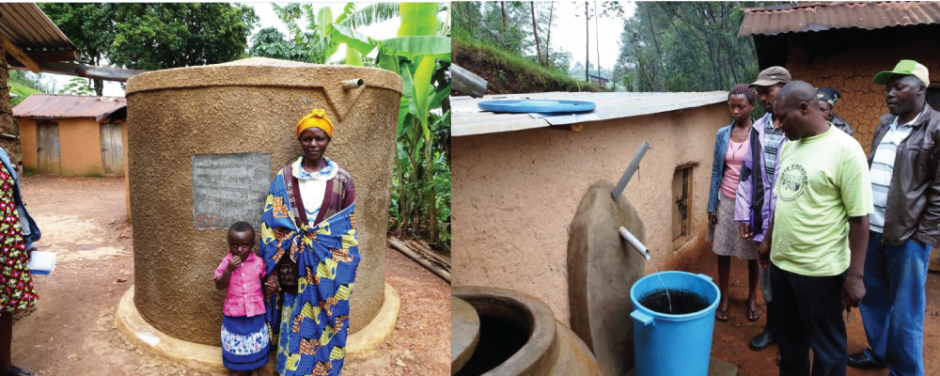
b) Tarpaulin Underground water harvesting tanks: 139 tarpaulin water-harvesting tanks were demonstrated and adopted (40 in Kisoro, 49 in Kanungu and 50 in Rukungiri district). Construction of these tarpaulin water tanks was done by BSPs who are being paid by beneficiary households at fee of 50,000-70,000 UGX 28 BSPs (2 per Sub County) have been identified and skilled by hired artisan to scale up adoption of tarpaulin water harvesting tanks in the region.
c) Scaling up of hill management: USAID ICAN partnered with a local nursery bed operator who trained 4 hill management committees (3 in Kisoro and 1 in Kanungu) to promote soil and water conservation on hill slopes using bamboo. 20000 ready-to-plant bamboo seedlings. 5000 seedlings were planted on Kamena hill, 5000 were planted on Busigi hill in Busanza Sub County, 5000 were planted on Mihanga hill in Murora Sub County and 5000 were planted on Kanyashogyi hill in Mpungu Sub County. 4 bamboo nursery beds were also established in Kanungi and Kisoro to scale up soil conservation on hills (1 in Mpungu sub county in Kanungu, 3 in Kisoro district).
d) Support schools to establish tree nursery beds and community nursery beds: Through a local nursery bed operator, 1135 pupils (150 pupils in Kisoro, 882 pupils in Kanungu and 103 pupils in Rukungiri) were trained on school tree nursery and 4-community bed establishment for calliandra. In all schools, children participated in planting of calliandra seeds in nursery beds. This activity kick started during staggered reopening of schools after the 1st COVID-19 lockdown targeting 75 primary schools in Kanungu, Kisoro and Rukungiri districts. Transplanting of calliandra seedlings by community members, parents and has kick started following available rains
SUB-PURPOSE 2: IMPROVING NUTRITION, ESPECIALLY AMONG WOMEN AND CHILDREN
a) Training of livelihood groups on Nutrition related interventions. 1678 community groups comprising of 36999 members (11904 males, 25095 females) received trainings on nutrition related topics that included WASH practices, family planning and vegetable growing and nutrition screening for children. ICAN VHTs leveraged on community group leaders and BSPs and disseminated messages on nutrition practices focusing on WASH, nutrition screening and family planning.
b) VHT orientation and training on new tools and job aides:
District Old VHTs
New VHTs
Total
Male Female Male Female
Kanungu 18 42 1 8 69
Kisoro 27 43 5 7 82
Rukungiri 13 44 1 15 73
Total 58 129 7 30 224
224 Village health teams (187 old and 37 new VHTs) in Kanungu, Kisoro and Rukungiri district were trained on the MIYCAN curriculum and reporting tools. Of these, 65 were males and 159 were females. The VHTs were trained by health TOTs to increase proper food choices, good health and reduce the double burden of malnutrition in communities. VHTs were encouraged to continue supporting mothers on weekly basis and report to field officers.
District Group Preg Lact Others Total
Kanungu 404 1317 3734 2614 8069
Kisoro 441 1897 4683 2217 9238
Rukungiri 330 1108 3154 2329 6921
Total 1175 4322 11571 7160 24228
b) VHTs train old and new MYCAN groups: ICAN supported VHTs to reach 1175 MIYCAN groups (Kanungu=404, Rukungiri=330, Kisoro=441) during weekly trainings. 24228 mothers (4322 pregnant, 11571 lactating and 7160 care givers/others) were trained on nutrition sessions including WASH practices, backyard gardening, family planning and referrals, nutrition of babies and young children, breast feeding and HIV, clinical assessment and referrals and adherence to government guidelines for COVID-19 such as hand washing, social distancing and maintaining hygiene practices in households.
C) Children reached with Nutrition Interventions. 24265 children (12856 male, 24265 female) under the age of five years (Kanungu=8384, Kisoro=8466, Rukungiri=7415) were reached during MIYCAN sessions by VHTs using a MUAC tape to ascertain their nutritional status. Of these, 655 children were in yellow MUAC (145 in Kanungu, 229 in Kisoro and 281 in Rukungiri) and 108 children were in red (Kanungu=28, Kisoro=52 and Rukungiri=28). The mothers and caregivers whose children were malnourished were advised to provide balanced diet to their children and practice best feeding practices.
c) Celebration Child Health days plus (CHD+0): USAID ICAN also participated in CHD+ activities and as a result, 11,180 children were reached out during CHD+ during the month of April 2021. These were 3,035 from Rukungiri, 2,344 children from Kanungu and 5,801 from Kisoro district. During child health days plus, health workers, ICAN field teams and structures (VHTS and BSPs) worked jointly mobilized communities to participate in CHD+ activities. Community members especially children and mothers received Vitamin A+, deworming and nutrition assessment and messages in family size and antenatal services.
d) Provide Messages on Family Size, FP and ANC Services: 6465 members from 390 groups (1820 males, 4645females) received messages on family size. Of these, 617 mothers (116 from Kisoro, 408 from Kanungu and 93 from Rukungiri) were referred for ANC services, 995 mothers (320 in Kanungu, 429 in Kisoro, 246 in Rukungiri) were also referred for FP and 197 mothers were referred for malaria, 1099 children were referred for vitamin A and 115 for other medical support.
e) Improving WASH Practices and access to Technologies: VHTs trained households on ensuring WASH facilities are installed following COVID 19 second wave. Emphasis was on hand washing facilities in their compounds, dry racks for plates and other utensils to dry before being used for serving meals in order to avoid sanitation related illness, establishment of composite pits, tippy taps and clean latrines places and practiced household hygiene. These practices were emphasized by resilience committees, LC 1 and bataka chairpersons. Most of the villages attest to reduced sanitation related illnesses and putting into practice COVID-19 guidelines. 24798 households (11738 households in Kanungu, 10504 in Kisoro and 2556 households in Rukungiri have so far established WASH facilities with minimum standards in their homes (clean and washable latrine surfaces, tippy taps, clean compounds and drying racks).
District Group Male Female Total
Kanungu 912 4016 7722 11738
Kisoro 554 3405 7099 10504
Rukungiri 169 687 1869 2556
Total 1635 8108 16690 24798
f) Promotion of enterprises and practices that enhance minimum acceptable diet and Diversity: 19797 households from 1056 groups were reached and trained on vegetable and kitchen gardens establishment. These included 6800 individuals from Kanungu district, 10497 from Kisoro, and 2500 from Rukungiri were supported by VHTs to establish and look after kitchen gardens and rear animals to supplement with animal proteins.
g) Monthly review meeting between VHTs and ICAN field Officers: Monthly review meetings involving VHTs and ICAN field officers were conducted in ICAN targeted sub counties. 224 VHTs (69 from Kanungu, 82 from Kisoro and 73 in Rukungiri) and 28 ICAN field officers participated. Progress update on MIYCAN activities, filled monthly data forms and action plan for subsequent month such as reaching out to more mothers in religious groups and other platforms were shared.
h) Orientation of religious leaders on MIYCAN: A one-day meeting with leaders of religious groups and Field officers was conducted to orient them on the USAID ICAN approach and seek their support in mobilizing mothers especially pregnant and lactating mothers that have not yet joined MIYCAN groups. The leaders were also called upon to give platform to structures especially VHTs and governance champions to pass on messages to the mothers on Nutrition and Education. The leaders responded positively and are encouraging mothers to join existing MIYCAN group sessions.
SUB-PURPOSE 3: YOUTH, ADOLESCENTS, WOMEN PARTICIPATING IN HOUSEHOLD AND LOCAL GOVERNMENT DECISION MAKING.
Training of teachers on Journeys and psychosocial support. During the year, USAID ICAN held a two-day refresher training of 812 teachers and head teachers from 85 schools on journeys by CCTs across all the 14 sub counties in Kigezi. The purpose of this training was to equip teachers, matrons, patrons with skills on how to cope up with stress and also how to handle Children through guiding, provision of psychosocial support and counselling while at school after these long periods of stay home due to COVID 19. The DEOs offices participated in the mobilisation and training of the teachers in their respective sub counties and gave teachers updates on reopening of schools, school development planning and School safety cognisant of Covid-19 Pandemib) Support school reopening during COVID-19. With the lifting of COVID-19 regulatory guidelines and reopening of primary schools for candidate classes, ICAN worked with all primary schools (30 in Kanungu, 30 in Kisoro and 25 in Rukungiri) and ensured that all SOPs of COVID-19 were fulfilled for school reopening for pupils in staggered manner. 4348 pupils were supported with revision material. Of these, 289 pupils from 10 primary schools in Kanungu district were supported by 20 volunteer teachers to revise sets of pre-PLE sets to improve on performance.
c) Remedial learning during covid-19 second wave. 2520 learning materials were procured and yet to be distributed to the learners take on their remedial classes, P.6 classes in Rukungiri will receive 480 pieces, 600 Kanungu and 600 for Kisoro), while P2 and P.3 classes in Kisoro will receive 600 and 240 pieces respectively.
108 primary six teachers guide (48 Rukungiri, 60 for Kanungu) were also procured and yet be used by teachers remedial classes
ICAN is in discussion with USAID, parents and district task forces to support remedial learning for P1, P2, P3 and P6 COVID-19 lockdown. Courtesy visits to District Education Offices in Kisoro, Rukungiri and Kanungu and preparation to support remedial learning for primary pupils. ICAN shared implementation plan and permission request for the activity buy-in and for support from Covid-19 task force. ICAN will work with district stakeholders especially district DEOs to support in identification of the learning centers and volunteer teacher to support the activity. We have so far identified 30 teachers and fifteen learning centers in Kanungu district.
a) Partnership with communities for school resilience in disasters. ICAN supported school governance structures 85 in Kigezi (30 in Kanungu, 30 in Kisoro and 25 Rukungiri) to refine their School Development Plans during covid-19 epidemic. The schools worked with governance champions and field officers to integrate disaster responses and mitigation measures into their plans. Key actions developed included installation lightning conductors planting of trees in school compounds to act as windbreakers and shades , mobilize of parents to support school development and provide scholastic materials for their children .
Joint Community Action.
a) Training of Governance Champions. 28 Governance champions (Kisoro=10, Kanungu=10, Rukungiri=8) composed of (24 males and 4 females) were trained on their roles and responsibilities, Community dialogues, GBV prevention and response and resilience planning. The governance champions will support ICAN targeted to implement school development plans and community actions. They were also taken through community resilience tool kits and how they can support communities in making joint action plan on we can do 5, and implementation of fruit tree of commitments as behavioural nudge for ICAN Kigezi region which symbolizes an accountability mechanism. Governance champions were introduced to all ICAN structures (BSPs, matrons and patrons, local leaders, Bataka leaders, school management committees and PTA and other stakeholders for resilience planning and community mobilization. b) Training or Participation in Governance Activities. 10,139 community members (3,259 males, 6,880 females) participated in the community resilience planning process. Seven hill management committees also held discussions on scaling up bamboo planting on hills in Kisoro and Kanungu to reduce on the rate / magnitude of mud/landslides occurrences. ICAN collaborated with the Mgahinga Cultural and Craft Center, local nursery bed operators and trained the hill committees in hill management practices and planting of trees, water and soil conservation structures installed and planting of bamboo seedlings is ongoing on 5 hills slopes in Kisoro and Kanungu districts. The other topics covered during the meetings were community action planning, Group leadership, Disaster planning, mitigation and management, Keeping of children safe in homes amidst COVID-19 lockdown.
c)Disaster management meetings. In FY21, ICAN facilitated 10 sub-county Disaster Management Committee meetings in Kanungu and Kisoro district. The meetings reviewed committees’ progress in responding to disasters considering new and anticipated shocks and stresses. Participants discussed mitigation measures to incorporate COVID -19 related shocks and stress, floods in Kisoro and Kanungu, WASH and teenage pregnancies. ICAN will continue to support the districts and sub-counties to update disaster management plans to include new anticipated shocks and stresses such as COVID-19 epidemic.
Challenges:
Challenge(s) Steps taken to address the challenges or plan to address them
Inadequate reporting tools especially MIYCAN and livelihood registers as this may compromise the data quality. The newly modified tools were procured and distributed to structures for data collection and reporting. ICAN also reoriented field staff and structures on new reporting tools.
The COVID-19 threat, and the existing government restrictions potentially still affect full-scale implementation of activities. We promptly encouraged our FOs and structures to adhere to government guidelines on COVID-19 by encouraging smaller group meetings, door-to door trainings that were used by VHTs and supported our staff and structures with sanitizers, Mask and liquid soap during field implementation.
The political environment and presidential election period (Jan-March) potentially affected full-scale implementation of activities. We made sure that we adjusted our schedules and concentrated on activities that did not create bigger gathering, guided our staff and structures to be nonpartisans during elections and after elections.
In school education activities were affected by covid-19 epidemic. This affected achievement of results for interventions targeting primary school learners. ICAN is working with parents and community leaders to provide remedial lessons targeting in-school children that are still at home (P1, P2, P3 and P6 in designated learning centers in Kanungu, Kisoro and Rukungiri district)
Collaboration with non-governmental partners: in FY21, Coordination meetings, seasonal review meetings and joint implementation of activities were held with private sector partners and government related departments. These were intended to bridge communication and collaboration gaps in coffee production and its value chain, IRBs promotion and perma-gardens and joint planning. These partners involved were OWL, Bugara women seed producers, Yield harvest Uganda (YHU) and Manyakabi Area cooperatives (MACE). We also continuously collaborated with related district departments such as production, community-based services, education, and health to implement ICAN activities.
Collaboration matrix
Partner Activities involved
Omukazi W’omutima ltd (OWL) OWL enrolled 4604 coffee farmers in Production, marketing, and good agronomic practices (in Kirima, Kihihi and Nyanga sub counties) Kanungu district.
Private partners (Bugara women seed producers, MACE and Yield Harvest Uganda, KEGRA) Production and marketing of iron rich beans and perm gardens for nutrition and income, access to quality seeds, good agronomic practices and consumption of Iron-rich beans recipes.
Structures (local councils, VHTs, BSPs, SMCs, PTAs, mentors and Governance champions) Engaged in identification of project beneficiaries, training of project beneficiaries, data collection and follow-up of activities and resilience planning.
Local nursery bed operators and Agro input dealers (clear and general stores, Phirez international Ltd, Kibimbiri rice farmers, Kisoro farmers house, MCC&C) These were engaged in training of 5 hill management committees on bamboo multiplication and planting on hill slopes, linking farmers to agro-inputs and formal agricultural markets and training on good agronomic practices for value chains.
Financial service providers (Micro finance support center, centenary bank, Post bank, SACCOs, BRAC Uganda) Facilitated Financial awareness meetings, literacy and credit meetings, opening of group and individual bank accounts and credit access. MSC is also working with ICAN to train Murora AGYW group on bakery project management.
District / sub county local governments (DEO, DCDO, Production offices, health) Regular technical support supervision, monitoring and coordination of project activities, enforcement of government guidelines on COVID-19, group registration and linkages to government programs such as UWEP, Youth livelihoods
MONITORING AND EVALUATION:
• The project’s monitoring and evaluation (M&E) activities during year consisted of collecting, storing, analyzing, and transforming data into strategic information for improvement, management, and advocacy of the project. Specifically:
• From the data collected and analyzed, it was observed that beneficiaries close to agro in put shops have many linkages on crop input market and contributed to improved crop agronomic practices especially in Kihihi Sub County. This has informed the region to scale up agro in put shops in other project areas.
# Indicator Annual Target FY2021 Actual Variance (Explain reason for under or over achievement)
1. Number of individuals [directly] participating in USG food security programs 86920 76778 (52547 Livelihood participants +23,053 MIYCAN participants+448 AGYW+60 youth champions+377 BSPs+225 VHTs +40 mentors + 28 GCs). COVID-19 Restrictions hindered movement, accessibility and mass group trainings.
2. Number of households reached with support for increasing economic opportunities through agriculture, non-agriculture-based livelihoods, and improved connection to markets and financial services (including income 61480 43089 The target was no reached because low numbers of group participants, restriction by covid-19 epidemic and some groups not meeting the selection criteria.
3. Number of for-profit private enterprises, producers' organizations, water users' associations, women’s groups, trade and business associations and community based organizations (CBOs) that applied/demanded improved organization-level technologies or management practices with USG assistance (EG.3.2-20)* 1590 1778 12% Increment was a result of strong collaboration with local government and private sector partners
5 # of BSPs 398 378 There was change in methodology of working with old BSPs to service newly profiled groups other recruiting and training new BSPs for groups. Some new groups were attached nearer to old BSPs.
6 Number of VSLAs established (people reached with training, grants, loans, or linkages to markets and programs for non-agriculture-based livelihood options) 2385 1809 More 236 groups are active but have not been reached out 3 times.
7 Number of individuals participating in group-based savings, micro-finance or lending programs with USG assistance 44520 52547 Increased enrollment in the groups of 29 average per group let to 18% over achievement
8 Number of farmers and others who have applied improved technologies or management practices with USG assistance 42930 32403 Local partners are still scaling up to more new sub counties
9 # of households adopting various tools & technology that reduce or mitigate shocks for specific local vulnerabilities 32198 31174 Local partners are still scaling up to more new sub counties
10 Number of ICAN beneficiary Members linked to [formal] Agricultural markets 15900 14645 92% achieved is due to Business opportunity meeting and collaboration with local private partners
11 Value of agriculture-related financing accessed as a result of USG assistance (per person/year) 0 667,845,900/= 52 groups accessed 72,840,000 and 2579 individuals accessed 595,005,900 Ugandan shillings from credit financial institutions.
12 Number of people who have used financial services (disaggregated by type, new, and sex) in the last 12 months as a result of USG assistance 44520 3936 Delayed engagement of Micro finance support center and other financial institutions. COVID-19 further limited the movement and thus access.
13 Number of ICAN beneficiary Members linked to [formal] financial markets and have opened accounts. 7950 2286 As of result COVID-19, financial institutions also had limited number of staff at their institutions as some of their staff operated at their homes, this delayed this activity.
Nutrition and Food Security
14 Number of MCGs that are operational 1080 1175 More 95 groups were profiled and reached out so as to improve on the performance of pregnant and lactating mothers
15 Number of women reached with nutrition interventions to improve diet diversification, IYCF, WASH, Child Spacing, through USG-supported programs 53000 47510 Average attendance of members was affected by COVID-19 pandemic and less membership of some MIYCAN groups
16 Number of pregnant and lactating women reached with nutrition interventions to improve diet diversification, IYCF, WASH, Child Spacing, through USG-supported programs (that year) 26500 15893 Low achievement was attributed by mothers not meeting criteria of being in MIYCAN
17 Number of children under 5 years of age reached with nutrition interventions (that year-NEW) 31800 41495 Over performance is due to a higher number of MIYCAN participants reached out from 1175 groups with an average of 20 members, mobilization during Children health days
18 Number of children under 2 years of age reached with nutrition interventions (that year-NEW) 19610 17981
19 Number of people reached with messages addressing norms and attitudes that lead to larger family size 15450 23053 Over performance is due to a higher number of MIYCAN participants reached out from 1175 groups with an average of 20 members, ICAN also leveraged on religious and livelihoods groups and this intensified mobilization.
Governance
20 Number of ICAN beneficiaries participating in community and local dialogue/governance forums (New each year) 6360 19495 BSPs and governance champions integrated community planning and governance sessions within community livelihood groups
21 Number of households participating in local planning and service delivery as a result of USG assistance 44520 15986 Underperformance is attributed to over estimation of the target
Cross-cutting
22 Number of people using climate information or implementing risk-reducing actions to improve resilience [to climate change] as a result of USG assistance (EG.11-6) 21465 27761 BSPS and partners induced increased adoption of NRM, Post-harvest handling, Improved crop agronomy practices and improved animal practices.
23 Number of people trained in climate change adaptation supported by USG assistance. 22260 25695 BSPS and partners trained more groups on NRM improved agronomy and husbandry.
24 Number of people supported by the USG to adapt to the effects of climate change. 4770 27761 BSPS and partners induced increased adoption of NRM, Post-harvest handling, Improved crop agronomy practices and improved animal husbandry practices.
25 Number of adolescents participants in non-farm income generation, income diversification, skills training, or Agriprenuership programming under ICAN 1590 508 COVID-19 effects led to drop outs , however ICAN scaled up 2nd Cohort AGYW activity in Kisoro ,the achieved target mentioned relate to 448 AGYW graduates in Kanungu and 60 youth leaders in Kisoro.
26 Number of parent teacher associations (PTAs) or community governance structures engaged in primary or secondary education supported with USG assistance (ES 1-13) 180 85 85 schools participated in the establishment of school nursery beds and revision of study materials. COVID-19 limited other activities.
27 Number of in-school adolescents reached with ICAN life-skills/Governance/Resilience messages 6095 4348 The indicator performance was affected by the outbreak of COVID-19 pandemic which led to the closure of schools, 4348 reached relate to number of children that were supported with revision materials during COVID period and those who trained on the establishment of school tree nursery beds.
Data quality challenges:
• USAID ICAN Caritas Kabale conducted data quality assessment targeting the partners and observed that private partners are supporting IP in achieving targets related to technology adoption and linkages indicators. However, the team found out that the one partner had data in a hard copy format that needed to be converted to the soft copy for easy reporting and also some farmers reached were not in existing. ICAN groups thus hard to be reported on by the IP, was advised and later converted the data in soft copy format as well as working with existing ICAN groups for easy reporting and the team resorted to continuous support to the partner for a strong MEL system.
• Data Quality assessment conducted in Quarter III and IV depicted improvement in data quality. it was learnt that online meetings were not helping enough like physical meetings. The staff interpreted presentations and guidance offered by the MEL officer during monthly meetings on data quality differently. This was confirmed by the different interpretation of some variables in the tools. The team shall therefore conduct a physical training in the beginning of the first quarter to ensure uniform interpretation.
• Under reporting. Data in the community group registers like production records was not being reported on, yet it exists. Some data like training reflected on the monthly summary missed on registers in a few cases and all these gaps were corrected.
• Financial indicators set were over estimated. In addition to business opportunity meetings and linkages to microfinance support center, the adoption rate is low to achieve the anticipated target.
Lessons learned
• Business opportunity meetings are so essential as the BSPs are availed with information on how to do business with the Private sector.
• Involvement of the government stakeholders is key in implementing a resilience project. There is need for continuous engagement, information sharing and joint supervision and monitoring.
• Many groups want to be registered to be able to access opportunities that may be available from the government and other partners especially ICAN. Therefore, ICAN will continue to work with CDOs to provide information on group registration up to district level.
• The approach of establishing model villages has been beneficial in tracking the progress of the we can do 5. Model villages without resilience committees are not doing well in adoption unlike those with village resilience committees that monitor the behavioural change among the communities they oversee.
• Magazine talk shows and recorded field dialogues are relevant in educating masses on various health aspects. In the end, they become empowered with knowledge and skills that enhance sustainability of the program and adoption of positive behaviors.
• Scaling up of the Youth leadership curriculum to more areas benefits the youth in shaping their confidence, public speech, leadership and paves a way for various livelihood ventures.
• There is need to scale up the community resilience tool kits to all sub counties because it registered success in the model villages it is currently being implemented with regard to We Can Do adoption.
Modifications in planned program activities:
• In school activities. Not all in school activities were implemented as earlier planned in FY21. This was due to COVID-19 epidemic that led to closure of education institutions. ICAN has worked with stakeholders especially district task forces to redesign covid-19 sensitive education activities during implementation period. Activities implemented were distribution of home-based revision packages to pupils, support to remedial learning targeting P7 candidates and training of teachers on journeys and psychosocial support, support to schools to adhere to covid -19 guidelines and go back to school campaigns.
• District disaster management meetings. This activity was incorporated within COVID-19 task forces. Districts efforts towards implementation of this activity were focused on covid-19 epidemic, response and strategic planning.
• Entry into new sub counties. This activity was not approved by USAID. The need to scale up to all villages and parishes within old sub counties was realized. ICAN team was therefore requested to cover all areas with interventions.
Finance, operations, and compliance:
• Implementing the accounting system and procedures to ensure compliance with financial regulations and funding partner guidance: Quick books accounting software has been introduced, this promoting good financial reporting and compliance. Procurements are always made and effected according to set standards which include, approved minutes of procurement committee – including bid analysis of at least three quotations as per policy in place, Verification that the supplier is on the prequalified suppliers list, copy of fully signed local purchase order, Copy of delivery note, Vendor’s invoice with VAT line, Payment Receipt, original receipts, vouchers, and tax invoices for all VAT payments.
• Coordinating the budget preparation process and providing periodic budgetary control information to the project. Budget performance evaluation (Actual Vs Budgeted) is always done on a weekly, monthly, and quarterly basis.Payroll is always made every month and salary payments effected to every staff done upon their audited and correct filled time sheets The full compliance with URA and NSSF filling and remittance deadlines is always done Handling day to day accountabilities of USAID-ICAN project, this has been affected through verifying field activity documents/accountabilities including activity attendance sheets, activity reports, Vehicle/ Motorcycle log sheets, receipts
Capacity strengthening:
• Skills in report writing and success stories. The regional success story writing committee submitted several success stories to Kampala for approval and submission to USAID. In FY21, ICAN oriented staff on different skills that included report writing and effective communication during implementation of ICAN activity.
• The MEL and program team participated in data collection and report writing sessions that are regularly for effective data analysis and reporting. These meetings are usually organized by MEL office in Kampala and have improved our capacities in reporting writing as evidenced by weekly, monthly, quarterly and annual reports.
• During review meetings with field staff and structures, our focus is usually on reorientation on program implementation, understanding of strategies and approaches, interpretation of new reporting tools and job aides.
• The finance team in the region has been trained on use of use of mobile money platform (Yo-Uganda) while effecting day-to-day payment of service providers and activities. The team will continue using this financial innovation for effective financial accounting and reporting. The team however require further trainings on use of QuickBooks and other financial management packages.
Technical assistance needs:
• Training of all staff on MEL and reporting
• ICAN small grants - training on all processes and grant application.
• Training finance teams on use of QuickBooks and financial management packages
• Capacity building in CV writing, public speech and personnel development.
• Staff reflection and stress management
• There is need to strengthen capacity of all staff and governance champions in resilience planning toolkit and implementation.
Activities planned for the next quarter:
Note Y means that activity will be done in that month
Activities Planned for Upcoming Quarter Dates (Oct-Dec) 2021 Location
Operation Meetings October November December
Management Bi-weekly, monthly and quarterly project meetings. Y Y Y Kabale
Orient ICAN staff and interns on MEAL concepts and new tools- 5 Days Y Kabale
Exposure of IP staff to new approaches/technologies on nutrition and livelihood X TDB
Train finance teams on use of QuickBooks. Y Y Kabale
Staff capacity building on CV, Public speaking, reflection, and Stress management Y Mbarara
Livelihoods
Private Partner Engagements- Increase number of private sector players in old sub counties Y Kisoro, Kanungu, Rukungiri
Work with MSC to operationalize Bakery project with AGYW in Murora-Kisoro district Y Kisoro
Work with Yield Harvest, Manyakabi ACE and Bugara Women to set up additional demonstrations for 2nd season and scale up in other sub counties. Y Y Y Kisoro, Kanungu, Rukungiri
Work with Partner/UGACOFF to continue with coffee value chain activities in Kanungu and scale up in Rukungiri district- Y Y Y Kanungu, Rukungiri
Master trainers orient BSPs on Graduation Y Kisoro, Kanungu, Rukungiri
BSPs strengthen VSLA/Farmer groups Y Y Y Kisoro, Kanungu, Rukungiri
Work with skilled artisans to train additional BSPs and scale up adoption of low cost tarpaulin water harvesting tanks and energy saving technologies Y Y Kanungu, Kisoro
Link mature groups to government programs such as Emyooga, YLP, UWEP, Parish Development model, etc) Y Y Y Kisoro, Kanungu, Rukungiri
Work with selected BDS specialists across the regions to submit livelihood grants – at least 4 grants per month Y Y Y All districts Kisoro, Kanungu, Rukungiri
Field Officers hold a half day meeting BSPs to assess progress towards goals Y Y Y Kisoro, Kanungu, Rukungiri
Nutrition
Train all VHTs on family MUAC concept-Facilitate VHTs on use of family MUACs Y Kisoro, Kanungu, Rukungiri
Support VHTs to reach MIYCAN group members using a door-door approach Y Y Y Kisoro, Kanungu, Rukungiri
Train VHTs in promotion of appropriate WASH practices Y Y Y Kisoro, Kanungu, Rukungiri
Support ICAN structures and staff with Covid-19 PPEs Y Kabale
Support households to establish Perma-gardens with nutrient-rich foods-KEGRA Y Y Y Kisoro, Kanungu, Rukungiri
Support VHT system Y Kisoro, Kanungu, Rukungiri
Governance
Support learners during Remedial Learning(P1, P2, P3, P6) Y Kisoro, Kanungu, Rukungiri
Work with Ubuntu in Kisoro district, government champions and Bataka leaders to scale up community dialogues. Y Kisoro
Strengthen linkages and coordination between the community structures and the government at all levels Y Y Y Kisoro, Kanungu, Rukungiri
Participate in the District as well as Sub-county COVID-19 taskforce meetings that takes place every week. Y Y Y Kisoro, Kanungu, Rukungiri
Gender youth and SBCC
New AGYW camps Y Rukungiri
Youth leadership training scale up Kisoro, Kanungu, Rukungiri
Radio programs Y Y Kisoro, Kanungu, Rukungiri
Scale up model villages Y Y Y Kisoro, Kanungu, Rukungiri